
Glossary

Amethyst
Amethyst was once considered to be as valuable as Ruby and Emerald; it regularly adorned jewellery worn by Royalty and religious figures.
The Ancient Greeks believed wearing them would guard against drunkenness (if only!) and it was popular with the Egyptians as a stone for carving intaglios.
Significant sources include Brazil, Russia, Uruguay and Zambia. It frequently occurs in large sizes and crystals can weigh hundreds sometimes thousands of carats.
Description: The best known and best loved member of the Quartz family, Amethysts vary in colour from the palest blush mauve to the deepest regal purple. They are found in Brazil amongst other places.
Hardness: 7 on Mohs Scale
Birthstone: February

Aquamarine
Aquamarine is often heated to intensify the colour and remove green tones, resulting in the strong blue coloured stones most often seen in jewellery.
The colour is caused by tiny amounts of iron present in the crystals and large clean stones are not uncommon. Legend has it that Aquamarine (which means seawater in Latin) was the treasure of Mermaids and that might just be right! On land it can be found in countries such as Mozambique, Madagascar and Zambia.
Description: Aquamarine is the blue-green variety of the Beryl family and is found naturally in a range of shades varying from pale bluish-green through to a strong sky blue. It can be found in Brazil amongst other places.
Hardness: 7.5 – 8 on Mohs Scale
Birthstone: March

Bee
‘Once Summer days seemed swarming with bees. Not anymore… where have they gone? From a single bee bracelet to a big honeycomb cuff there is a spectrum as broad as nature in her infinite variety. It’s so sad to think our busy little friend is disappearing along with so much we love in the world. This must stop! Wear your bee with pride!’

Bodkin
A Theo Fennell classic, the Bodkin collection pays homage to timeless glamour and design. The Bodkin Collection uses a subtle & sinuous design like a light frame to best show off some of the most beautiful stones, so that they are allowed to be the stars of the piece.
Elegant drop earrings and matching pendant necklaces perfectly exemplify Theo’s love of simple but striking shapes and exquisite craftsmanship.

Bombé Ring
The Bombé Ring has become an icon for Theo Fennell with no two the same. It was one of his first designs & is now a much coveted piece of colourful jewellery. Theo loves reworking it in different coloured golds and with different stones and motifs to ensure that each permutation is fresh and unique.
There is a dramatic choice of stones including diamond, emerald, sapphire, ruby, blue topaz, pink tourmaline, peridot and amethyst – the combinations are as unique as they are colourful.
For a more personal touch, Theo can use birthstones to mark a special occasion. Colourful stones, extravagant cuts and intricate gold detailing are combined to create a magnificent ring.

Bud
Inspired by Japanese blossom, the Bud Collection is colourful yet subtle and beautifully elegant. It is richly symbolic of the ephemeral, fragile and transient nature of life due to the blossom’s short blooming season.
Available in eight gemstones; Diamond, Ruby, Sapphire, Emerald, Peridot, Blue Topaz, Pink Tourmaline and Amethyst, the delicate pendants and earrings would make the perfect present for all ages.
The perfect proportions and unusual settings demonstrate Theo Fennell’s immense attention to detail and ability to create traditional yet unique jewellery.

Celestial
“Who doesn’t look up at the Celestial Sky at night and find it endlessly beguiling and overwhelming? Is there anything more inspirational than the beauty of the starry heavens or anything else that better reminds us of how lucky we are to be alive below them?” Theo
Celebrating the wonders of the natural world Celestial Night takes its inspiration from the wonder of the nocturnal sky. The beauty of the moon, the stars and the planets above our heads gives us a hint of the cosmic vastness of the universe, how lucky we are to be alive on earth and how deeply we need to cherish that privilege.

Chrysoberyl
Some Chrysoberyls exhibit an optical phenomenon known as the ‘cat’s eye effect’ whereby a streak of light bisects the stone, caused by reflection off a multitude of fine needle-like inclusions.
But the most highly prized variety of Chrysoberyl is Alexandrite which changes colour from red in artificial tungsten light to green in daylight. Originally discovered in the Ural Mountains in Russia, it was named after Tsar Alexander II.
High quality examples with a really pronounced colour change are amazing to look at and very rare so are hugely expensive.
Description: This gemstone occurs in yellow, green and brown colours, but in spite of its name, it is not a member of the Beryl family, which is confusing! The best examples are found in Brazil and Sri Lanka.
Hardness: 8.5 on Mohs Scale
Birthstone: June

Chrysophase
Is a kind of Chalcedony but with nickel in it that so often gives it a green colour. The shade can vary from eau-de-nil to an deep apple green but, whatever variation, often has black markings that can give it a crocodile skin appearance. Being opaque, it is its colour that makes it desirable. Rumanian legend states that a person who works with a Chrysoprase has the ability to understand the language of lizards.
Description: It is found all over the world but significant amounts are found in Australia, Russia, USA, Brazil and, strangely the biggest deposits of all are in Poland.
Hardness: 6 – 7 on Mohs Scale

Citrine
Citrine is not naturally found in large quantities, so many of these stones are Amethyst or Smokey Quartz that have been heated. Sometimes Citrine and Amethyst will grow together in the same crystal, when these are cut it produces stones that are half purple and half yellow which are called Ametrine.
One of few British gems, they have been found in the Cairngorm Mountains of Scotland (where they are referred to simply as Cairngorms) and were frequently used in Scottish jewellery in the 19th Century when the stone was made popular by Queen Victoria.
Long before that however they were believed to provide protection against the plague, skin problems, snake bites, and evil thoughts. So who wouldn’t want one of these!
Description: Citrine is the yellow variety of the Quartz family, it ranges from palest lemon through to a rich golden orange. Brazil is the most prolific supplier of these sunny gems.
Hardness: 7 on Mohs Scale
Birthstone: November

Cross
“The Cross is one of my favourite shapes and has a million permutations, but concept and craftsmanship are vital. A badly proportioned cross is an insult to design.” - Theo

Cufflinks
‘Cufflinks are one of the few ways a man in a suit can display his own individuality and style; so we like to design and make them to be as stylish as individual as possible.’
We design and craft many unique and original cufflinks for our patrons all the time. They can be made from scratch, employing our wealth of skills, techniques and materials or tailored from any of the designs here to be rendered completely personal. We can use racing colours, favourite views, portraits, cars or animals, for instance, to personalise any pair.
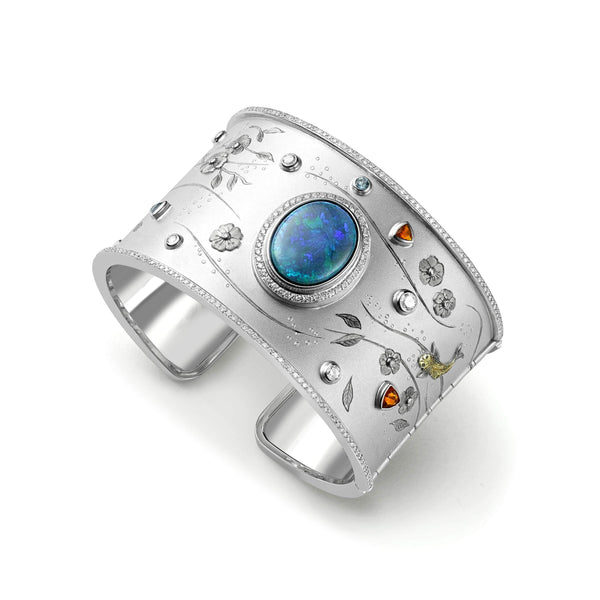
Cuffs
Cuffs are solid bangles as opposed to bracelets, made either with a gap to slip across the wrist or with a hinged opening with a snap.

Diamond
Diamonds account for the vast majority of the value of all gemstones bought worldwide, some estimates put the figure as high as 90%.
A pure diamond is colourless and entirely composed of carbon, however they can also occur in a range of other colours (termed Fancy Colours) including brown, yellow green, pink, blue, black, red and purple.
They are valued according to a system known as ‘The 4 C’s’ which are Carat – how much they weigh and therefore how large they are, Colour – how white they are or alternatively how strong the colour is in Fancies, Clarity – how free they are from tiny inclusions or marks, and finally Cut – how well the stone has been cut and polished. However none of these grades and measurements allow for the inner life and romance which some stones possess and others simply don’t, that certain star quality that makes some of them just sing!
The term ‘Cut’ is also commonly used to refer to the overall shape of the stone, with the Round Brilliant being the most popular choice. The brilliant-style of cutting, which refers to the number and positioning of the flat polished faces or ‘facets’ of a stone can also be applied to other shapes of diamond such as oval, pear and marquise.
However for those who prefer a more geometric shape, the emerald cut (which is essentially a rectangle with the corners cut off), the princess cut (a square with brilliant-type faceting) and the Asscher cut (also square but with its corners removed and named after the gentleman who designed it in 1902) are all good choices.
The name ‘diamond’ comes from the Greek word ‘adamas’ meaning unconquerable and the earliest written account of diamonds dates from around 500BC. Until the 18th Century, they were to be found only in India which meant that diamonds were genuinely rare, very expensive and therefore worn only by Royalty and the very wealthy. In 1725 they were discovered in Brazil but it was the young boy in South Africa, who in 1867 found a colourless stone on the ground at his father’s farm, who changed the history of diamonds most significantly. The subsequent huge increase in diamond mining and production meant that for the first time, diamond jewellery was more widely available. Today, some of the most important gem diamond producing countries are Australia, South Africa, Canada and Russia. Being the hardest of all gemstones it is a favourite for engagement rings.
Description: Diamonds are the most famous and commercially important gemstones in the world, they occur in a range of different colours with white being by far the most often used. They are found in several countries including South Africa, India and Canada, and are the hardest naturally occurring substance known to man.
Hardness: 10 on Mohs Scale
Birthstone: April

Emerald
The most desirable Emeralds have a good strong colour, and a bright, lively appearance. Traditionally the finest quality are found in Colombia, in particular three key mines, Muzo, Coscuez and Chivor.
Other great mining regions now include Brazil and India not to mention Zambia where the company Gemfields are putting a huge amount of resources into mining some very beautiful stones, take a look at our Kissing Frog ring and our Emerald and Ruby bead ring and tassle necklace for proof!
They frequently have tiny feathers and crystals inside them and this internal landscape is referred to as the jardin; these inclusions can be used almost like a fingerprint to identify the origin of a stone. The emerald-cut is a simply faceted, rectangular shaped style of cut with the corners removed and was developed especially for the emerald to help minimise any damage to the stone caused by its brittleness.
The earliest record of emerald mining was by the Ancient Egyptians, indeed Cleopatra was such an ardent fan of these green gems that she reputedly had her own mine.
Throughout history Emeralds have been thought to possess a surprisingly wide range of attributes, from the belief held in the Middle Ages that wearing one would keep a woman virtuous (not so for men sadly) to its ability to soothe tired eyes, aid memory, improve eloquence and attract good fortune to the wearer.
Combine all that with its reputation as the stone of love and eternal youth and it’s no wonder Theo named his daughter after this delightful and seemingly all-powerful gem!
Description: Emerald is the head of the Beryl family, highly prized for its rich vibrant green colour which is caused by traces of chromium in the crystals. Colombian stones are widely regarded as the crème de la crème, but which colour and from what source is very much a matter of taste.
Hardness: 7.5 – 8 on Mohs Scale
Birthstone: May

Empress
Our collection of exceptionally beautiful Empress pieces earned their name because of the Imperial Topazes we used in our original pieces. Now Empress is hand-crafted in our workshops, not just with the wonderfully broad spectrum of Topaz colours, shimmering pinks and honey-golds, but in other vibrant stones, Aquamarines, Opals and Orange Garnets among them, and as matching or single earrings and necklaces. Original and striking but elegant and wearable, each piece is unique and timeless and makes Empress a modern classic.

Enamelling
Enamelling – this is a process of fusing powdered glass to metal by firing at high temperatures (750-850 degrees C). The resulting melt hardens to a smooth and durable finish. The art of enamelling can be traced back to the ancient Egyptians, Greeks and Celts and was widely used in Russia and China
There are several different enamelling techniques used that can create a variety of effects, these include:
Guilloche – this is where the metal of a piece of jewellery or objet is engraved with a pattern, often concentric, and then covered with translucent enamel which highlights the detail beneath.
Plique à jour – the French term means ‘letting in the daylight’ which perfectly describes this technique which is essentially like a stained glass window. Small cells with gold or metal outlines are filled with enamel but have no back to them so when held up to the light the translucent colours come alive.
Cloisonné – the term comes from the French cloison which means ‘partition’ and refers to the small cells or shapes which are formed by wires fused onto a base and then individually flooded with enamel. This typically produces brighter more opaque colours.
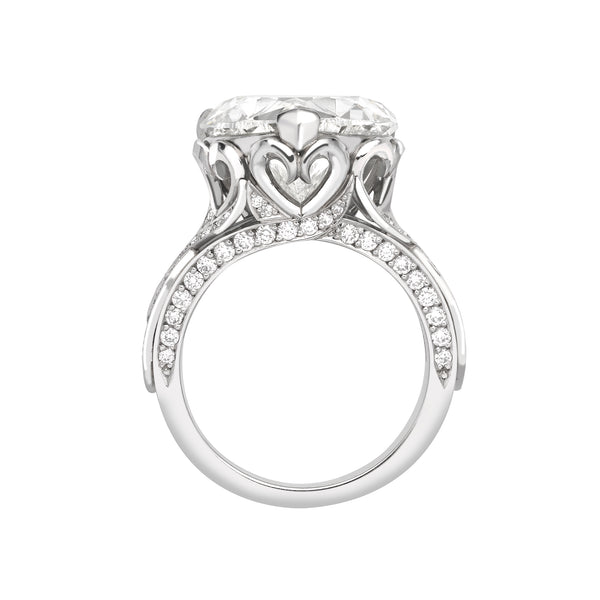
Engagement Rings
Engagement rings are a relatively new phenomenon and the idea of them being made with diamonds even more so. We believe they should be unique to the person or the couple, be set with any stones they love, reflect their characters and have highly personal details incorporated into the design. It seems odd to get the most personal piece of jewellery imaginable ‘off the peg’.

Engraving
This is where a pattern, design, writing or monogram is cut into metal using a sharp tool. Is the process of cutting into metal (though also stones and glass) to produce an image, pattern or written inscription with a sharp tool. Hand engraving and deep engraving are the most traditional forms of this art, achieved with a sharp tool called a scorper, by an engraver. This can take the form of a few words and dates, as on a trophy, through to the most complicated scenes and images.
Hand Engraving – At this level engraving is a true art form and engravers true artists.
Machine Engraving – Various machines are used for this from what is almost a dentist’s drill through to a wheel (much used in glass engraving). Although inexpensive and reasonably effective with modern techniques, this has none of the depth or artistry of hand engraving.
Engine Turning – Is as it sounds and is used to give the very geometric patterns used on old-fashioned cigarette cases and still much used for the background to transparent enamelling.
Laser Engraving – Gives a very quick and inexpensive but also very shallow finish.
Etching – The process by which metal is taken away to leave metal (or other materials) standing proud. This can be achieved by hand by talented engravers or by photo or acid etching.
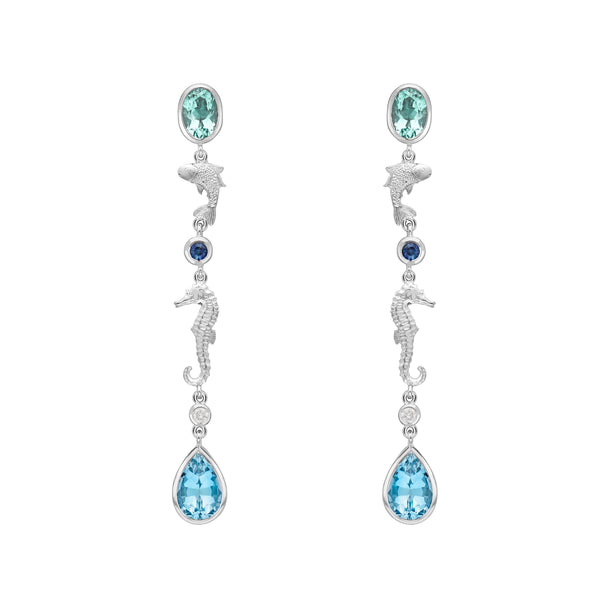
Fable
Fable is more a concept than a collection of bracelets, necklets and earrings made up from gold symbols and different stones to tell a story.
So, a bracelet might have anchors and seahorses, aquamarines and diamonds to tell a sea story or golden leaves and russet stones to represent an autumn tale.
Each one is different and fits with our love of storytelling in our jewellery.

Floribunda
Theo Fennell’s collection pays tribute to nature’s four seasons and the flora, fauna and colours that make each one quite so distinctive and magical.
Each 18ct gold ring showcases a vibrantly coloured stone surrounded by diamonds that corresponds to each season: the Spring Ring features a sunny Yellow Beryl, the Summer Ring a warm Pink Tourmaline, the Autumn Ring a russet hued Yellow Citrine, and the Winter Ring a frosty Aquamarine.

Forevermark
“These stones have been moved from one eternal setting to another.” Theo.
The Forevermark promise states that every diamond is ‘beautiful, rare and responsibly sourced’. Less than one percent of the world’s diamonds can carry the Forevermark inscription. A unique number inscribed at the heart of each diamond promises that each is beautiful, rare and responsibly sourced. Using proprietary technology, each Forevermark diamond is inscribed with a unique number, proof that it is of exceptional quality and utmost integrity – this number can be found using the Forevermark Viewer.
Every piece is handmade in our Fulham Road workshop by our talented craftsmen.

Garnet
At Theo Fennell we use many of these beautiful stones including Spessartine which is a deep fiery reddish-orange in colour and Tsavorite which is a rich grass green. The name ‘Garnet’ is derived from the Latin ‘granatum’ meaning pomegranate as the small red crystals of the variety Almandine were thought to resemble pomegranate seeds.
Garnet has long symbolised the bringing of light into darkness. For example, the Vikings were buried with garnet jewellery to help light the way to Valhalla and Noah is said to have used a beautiful cut gem on the ark to light his way through the dark and stormy nights.
Description: Garnets are a large family of gemstones and whilst typically thought of as being red, actually have a broad spectrum of colour and price. They are found all over the world, including Great Britain.
Hardness: 7.5 – 8.5 on Mohs Scale
Birthstone: January

Gemfields
Theo Fennell has an ongoing collaboration with Gemfields, the world’s leading coloured gemstone producer. Both the design and quality of raw materials is fundamental to the creative process and finished pieces.
By collaborating with Gemfields, Theo Fennell is able to access a consistent supply of rare coloured gemstones, and is able to partner with a company that, in addition to making every step of the process ethical and transparent, is committed to protecting the surrounding local communities and the natural landscape from which the gems are sourced.

Gold
A soft, shiny, yellow metal which occurs as nuggets or grains. 100% pure gold is too soft to be practical for use in jewellery so other metals (alloys) are added to make it harder wearing.
Sometimes these will maintain the yellow colour but they can also be used to change the colour of the gold, for example copper is added to make rose gold.
We use 18ct yellow, white and rose gold in our pieces which is the usual standard for fine jewellery, it is hallmarked with ‘750’, meaning that 75% is gold and 25% is a combination of other alloys.
Gold is a highly malleable metal, 1 gram can be beaten into a sheet large enough to cover 1 square meter and it does not oxidize in air or water, making it ideal for use in jewellery.

Hallmarks
These are small impressions or marks which are struck into a piece of jewellery or silver by official Assay Offices to guarantee the quality or fineness of the metal used, for example 750 for 18ct Gold and 925 for Sterling Silver. There are also marks to date a piece, to denote the maker or designer of the piece and also the place it was marked, e.g. London.

Yellow Beryl
Yellow Beryl also known as Helidor.
The name Heliodor derives from the Greek words ‘Helios’ meaning Sun and ‘doron’ meaning ‘gift’.
This bright gem can range from a pale lemon yellow to a deep golden colour which is caused by iron. It is one of very few gems that can occur as pure true yellow without green, brown or orange tones and large, clean stones with a rich intense colour are particularly sought after. Yellow beryl is found in many different locations, some of the most important are Brazil, Madagascar and Namibia. There is a spectacular faceted golden beryl on display in the Smithsonian Institute in Washington, at 2,054 carats it is the largest cut specimen in the world.
Description: The Beryl family of gemstones has several important members, the most notable of which is Emerald, however it also has a beautiful yellow variety known as Heliodor. It is found in Brazil.
Hardness: 7.5 – 8 on Mohs Scale

Heroes and Villains
Everyone’s Hero is someone else’s Villain. It is interesting that there is virtually no-one that is universally admired or universally loathed, though some come very close.
We have chosen people that, we hope, will illustrate this and who are iconic for different reasons. They have been sculpted by the finest miniature portrait sculptor in the world.
As Theo Fennell has do often done before, these portraits of heroes and villains revive one of the great traditional jewellery skills and makes genuine sculptures that are wearable art.

Horseshoe Ring
The double-headed design parts from tradition to place stones between the fingers and gives a very different aesthetic to a ring. It also allows some asymmetry and adventure with some otherwise classic designs.

Jade
Jade is made up of millions of tiny crystals that lock together meaning it is very tough and suitable for use in jewellery although it is also used extensively for carvings. The finest pieces come from Burma but it is also mined in Russia, Tibet and Guatemala. It has a long association with China where it is very highly prized, particularly the translucent apple green colour which is called Imperial Jade.
This is the rarest and most valuable variety however it occurs naturally in a range of colours including yellow, white, lavender, red and black. It is associated with prosperity, success and good luck.
Description: The name Jade is used to describe two different varieties of this gem, Jadeite and Nephrite, with Jadeite being the rarer and more valuable of the two. They are similar in appearance, occurring in many of the same colours and have the same hardness.
Hardness: 6 – 7 on Mohs Scale

Jasper
Jasper is made up of thousands of tiny crystals tightly packed together to form a hard opaque mineral. As such it can contain lots of different ‘ingredients’ which give rise to a multitude of different colour and pattern combinations, from black and white spots to red and brown streaks or green and pale pink round blotches.
It is typically used for ornamental carvings, beads, and inlays and its diversity of appearance means that it offers a great range of realistic looking options for carving pieces like our Sea Turtle and Crab cufflinks.
Description: Jasper is an opaque variety of Quartz that occurs in a wide range of colour and patterns, it can be found in many different countries including Egypt, Africa and the USA.
Hardness: 7 on Mohs Scale

Keys
Back in the early 80s, when our crosses, snakes and skulls were so popular, I felt a symbol that was nondenominational and had nothing but positive connotations. I was recovering from a minor operation and sitting with paper and a pencil in our old, 16th century house of the time and saw the big, old key sticking out of the ancient oak door and thought how great it looked.
Surprisingly, the key had hardly been used in jewellery through the ages except as a symbol of a twenty-first birthday – ‘key to the door’. I worked on a design that would be obviously a key but also be wearable and aesthetically pleasing. Thus our first key was born. That basic shape is one we have used, among many others, ever since and has been the basis of many permutations.

Kunzite
Kunzite is currently found in Afghanistan, Brazil, Madagascar, and America. It was discovered relatively recently in 1902 in California after unidentified pink crystals were sent to the renowned gem specialist George Frederick Kunz. He confirmed that the crystals were a previously unknown type of Spodumene, their beautiful colour caused by manganese.
These new pink stones were named after him and from that point on were known as Kunzite. They are frequently found free from inclusions and can occur in large sizes. The Smithsonian Institution has one of the largest, a faceted heart-shape weighing in at 880 carats.
Care should be taken when displaying, wearing, cleaning and storing these gems as they are susceptible to breaking and the colour can fade with prolonged exposure to heat and intense light.
Description: Kunzite is the light pink to violet-purple variety of a mineral called Spodumene, which is found in various locations including Madagascar.
Hardness: 6.5 – 7 on Mohs Scale
Fact: It is named after G.F. Kunz, a famous gemologist.

Labradorite
Labradorite is related to Moonstone and it occurs as a dark blue to grey opaque material or an almost colourless, yellowish or brownish material, both of which are admired for the vibrant iridescent colours they display which roam across the stone as it is turned. Although originally found in Canada (in the Gulf of Labrador – where the dogs were originally from!) it has since been found in Australia, Finland and Russia.
Description: Labradorite is a member of the Feldspar family of gemstones, it can be highly iridescent with blue, purple and yellow flashes and takes its name from where it was first found, Labrador in Canada.
Hardness: 6 on Mohs Scale

Lapis Lazuli
Lapis is actually classified as a rock because it is a combination of several different minerals, namely Lazurite (responsible for the fabulous colour) Calcite (the whitish streaks) and Pyrite (the little golden-coloured flecks).
Used for both adornment and decorative purposes for thousands of years, it is regarded as one of the first commercial gemstones. One of the earliest surviving examples of its use can be seen in the funeral mask of Tutankhamun. Later as it began to travel throughout Europe, it was ground into powder and used as a colouring pigment known as ultramarine which was widely used by artists such as Vermeer, for example in his well know work, Girl with a Pearl Earring – how apt! It is admired today, as it has always been, for its fabulous colour.
Description: Lapis Lazuli is a beautifully vibrant royal blue ornamental gem. It is one of the oldest gemstones and has been traded for thousands of years. Whilst the best quality still comes from the ancient source in the mountains of Afghanistan, it can also be found in Chile and Siberia and Canada.
Hardness :5 – 6 on Mohs Scale
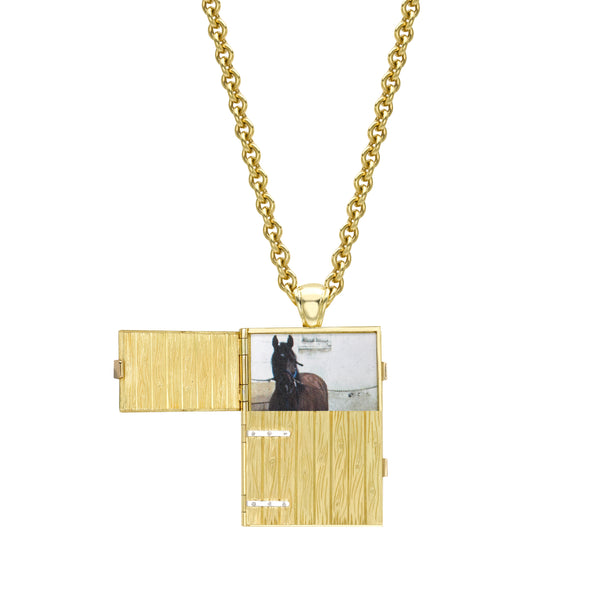
Lockets
Originally a keepsafe to wear or carry with a portrait of a loved one or a lock of their hair inside. Highly complicated to make well, we have developed them into a modern, original and wearable piece of jewellery.
Our most recognisable pieces are the collection of opening doors, of kennels, stables, London houses, portholes….anything that can open to reveal a favourite person, animal or scene, often represented in enamel.

Mammoth Ivory
Mammoth tusks are typically found deep frozen under the ice in Siberia where intrepid explorers spend the warmer months, which are obviously still bitterly cold, hunting these long-buried remains.
These mammoths’ tusks, which can exceed 13 feet in length, are steadily reemerging from the permafrost and are creating a prosperous trade that is benefitting the population of Arctic Siberia.
A single, good quality tusk can earn its finder a fortune.
A rich, creamy, opaque white in colour with tell tale curved banded markings, this material works beautifully for carvings and we use it in cufflinks, pendants and rings and for carving our iconic skulls.
Description: As its name suggests, this is ivory from the long extinct Woolly Mammoths who roamed the earth tens of thousands of years ago, it is excavated from under the ice in Siberia.
Hardness: 2.5 – 3 on Mohs Scale

Mohs scale of hardness
Devised by the German mineralogist Friedrich Mohs (1773-1839), this scale is a practical method of comparing the different levels of hardness of different minerals and gems. It is measured in terms of the ability of a material to resist scratching by those above it in the scale. It is a table of 10 different minerals, arranged in order from Talc the softest at number 1 to Diamond the hardest at number 10.
It should be noted that the levels of hardness are relative and the difference in actual hardness is greater between numbers 9 and 10 than between 1 and 9!
Fact: As a comparison with some more usually encountered materials in terms of hardness:
Graphite (pencil lead) – 1.5 Mohs
A fingernail – 2.5 Mohs
Window plate glass – 5.5 Mohs
Steel file – 6.5 Mohs

Moonstone
The best known and most desirable Moonstones are those with a near colourless, translucent body accompanied by a silvery blue sheen or reflection which appears to roam across the surface of the stone as it is turned and viewed from different angles.
They are usually cut as cabochons in order to best display this effect, which is called adularescence and results from a scattering of light caused by the internal structure of the stone. It has long been admired for its ethereal appearance and was particularly popular during the Art Nouveau period, when it was used to great effect.
Different cultures and societies have associated it with different values and properties, including the ability to foretell the future if you hold one in your mouth during a full moon – worth a try surely!
The stone leant its name to the first ever English detective novel by Wilkie Collins, called simply The Moonstone, although the stone in the story is actually a diamond whose brilliance was said to wax and wane with the light of the moon.
Description: Moonstone is the best known member of the Feldspar family and can occur in a variety of colours including white, yellow and brown, the most desirable stones have a blue-ish sheen to them and are found in Sri Lanka.
Hardness: 6 on Mohs Scale
Birthstone: June

Morganite
These pretty stones, which are always on the pastel side and not strongly saturated, offer a soft and gentle colour to our palette. The colours are caused by tiny amounts of manganese in the crystals and the best examples are currently being mined in Brazil and Madagascar. The stones are frequently heated to enhance the pink tones which are the most popular.
Previously known only as Pink Beryl, it was re-christened in 1911 by the gemmologist G.F. Kunz and named in honour of the famous American banker John Pierpoint Morgan. Morgan was one of the most important gem collectors of the early 20th Century and made many generous donations to museums in both New York and Paris – so that’s how to get a stone named after you!
Description: Morganite is the pink member of the Beryl family and occurs in hues from the palest sugared almond pink through to rose, peach and salmon coloured stones, it is found in Madagascar.
Hardness: 7.5 – 8 on Mohs Scale
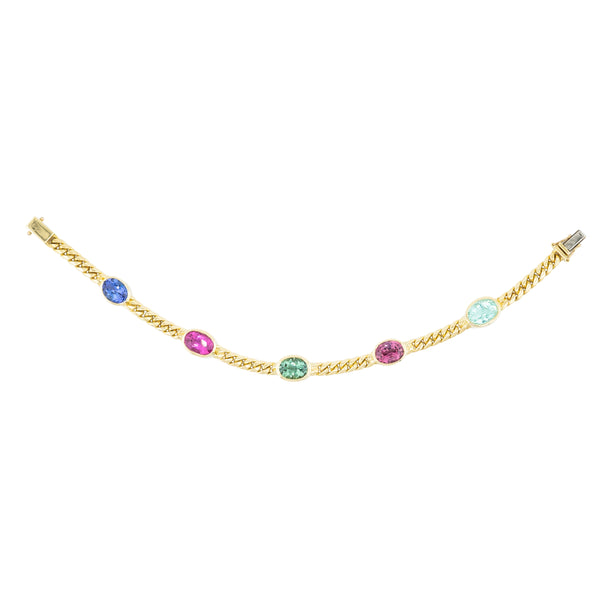
Motley
A beautiful word than means mixed or eclectic and such are the Motley pieces. Each one is unique and contains a mixture of stones in different colours and shapes.
As every piece is handmade, it can be as random as you like. Generally, in bracelets, necklets and earrings.

Mounter
This is the craftsman or woman, often referred to as a Goldsmith, that actually makes the body of a piece of jewellery. They fashion the piece for the setter to set stones into, the engraver to engrave, the enameler to enamel and the polisher to polish.
They are the person who follows the original artwork to achieve what the designer wants. As with all craftsmen, they are exceptionally talented artists in their own right and have supreme skills. They have been feted as the most talented of craftspeople for thousands of years.

Obsidian
Is, essentially, naturally formed glass… but what a dramatic formation. It is thrown up by the eruption of a volcano and the sudden cooling of the lava. It is given further character by those inclusions it picks up in its short metamorphosis. This means that desert sand to give it a rust colour or Cristobalite can give it a snowflake mottle rather than just its usual darting black colour.
It has been used for tens of thousands of years to make sharp tools and blades; as it still is today. It is found pretty much wherever there are volcanoes.
Description: Obsidian can be found in locations which have experienced rhyolitic eruptions. Acigöl town and the G.llü Dag volcano were the most important sources in central Anatolia.
Hardness: 5 – 6 on Mohs Scale

Onyx
Unlike the transparent varieties of Quartz such as amethyst and citrine, Onyx belongs to the group of translucent to opaque stones referred to as polycrystalline. It has been used since antiquity, both for jewellery and as an ornamental gemstone for carvings and statues.
Many cultures have put faith in its protective properties and have worn it in battle, to shield them from the evil eye and even during labour to ensure a safe delivery. Black gems have fallen in and out of fashion over the years, high points include the later half of the 19th Century when Queen Victoria, mourning the loss of her husband Prince Albert, wore a lot of black jewellery, making it very popular.
The following century, during the 20s and 30s it was in vogue once more with the monochromatic look popular during the Art Deco period.
Description: Onyx is the black sheep of the Quartz family, it is an opaque gem that can be cut or carved and polished to a high shine and can be found in Brazil, Sri Lanka and Madagascar.
Hardness: 7 on Mohs Scale

Opal
Opal is formed of tiny spheres of silica and the colours seen in any particular example depend upon the size and arrangement of these spheres. They have a relatively high water content, up to 5% which means they are susceptible to dehydration and should not be kept in hot or dry conditions. The Greeks thought Opal gave powers of foresight and prophecy and the Romans believed them to be a symbol of purity and hope.
Queen Victoria was a huge fan and not only wore them herself but gave them as gifts to each of her daughters for their weddings. The vast majority of gem quality opal is now mined in Australia; the town of Coober Pedy is a world famous source and Lightning Ridge is famed for its black Opals.
A relatively new source is the northeastern Wollo Province in Ethiopia, which became a major producer with the 2008 discovery of a large amount of white opal with a strong play of colour. The striking, bright orange-red stones that are mined in Mexico are also popular and are known as Fire Opal.
Description: Precious opals are prized for their vivid, iridescent, rainbow colour flashes which play out against either a dark or light background, Australia is the best known source.
Hardness: 5.5 – 6.5 on Mohs Scale
Birthstone: October

Opening Rings
Part of the great traditions of jewellery, opening rings fell out of favour for some time, mainly because they are incredibly difficult to make really well. Fortunately we have some of the finest craftsmen in the world in our workshop to make even the most complicated and exotic designs.
They allow for such a wealth of different techniques and interesting variations and we use all the skills there are to make miniature masterpieces. Many of these creations genuinely amaze even the most experienced jewellery collectors.

Palm
Inspired by the shadows of dappled light falling through palm leaves, the Palm Collection combines beautiful modern design with traditional craftsmanship to create a contemporary and unique style which is a signature of Theo Fennell.
Crafted from 18ct White Gold and Pavé Diamonds and 18ct Yellow Gold, the collection features earrings, pendants and cuff bangles which are timelessly stylish.
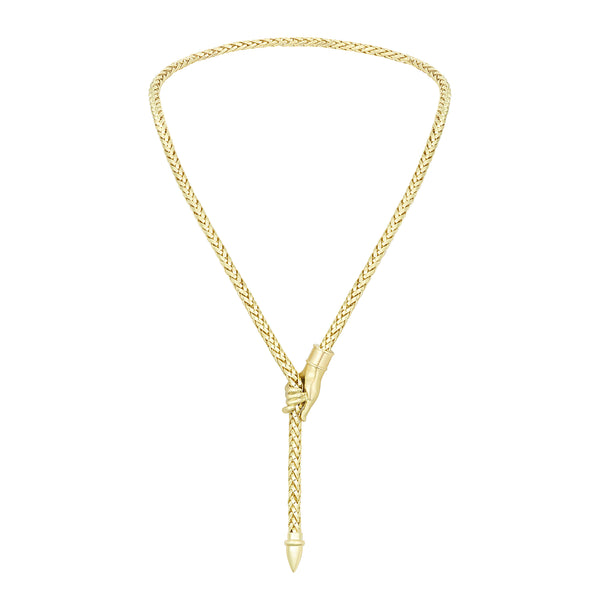
Palmier
Introducing Palmier… masterfully handmade by our talented team of craftsmen in our Fulham Road Workshop. Intricately woven from a continuous 18ct Yellow Gold flat ribbon wire, this is the finest example of the chain maker’s ancient art. The chain moves with an incredible fluidity, perfectly mimicking the lithe, slithering body of a serpent, whose head “bites” the other end of the chain, so that it can be worn at any length.

Paraiba
It was only discovered in the late 1980s and named after the state in Brazil where it was originally found. Clean stones of a good size and colour are rare and therefore extremely expensive. The intense colour of these stones is caused by copper and so gems of this variety, new deposits of which have very recently been found in Africa, are often referred to as Cuprian (meaning ‘copper bearing’) Tourmalines.
There is some debate as to whether or not the African gems should be called ‘Paraiba’ or if the name should strictly be reserved for those stones mined in Paraiba.
Description: Currently the most sort after and highly prized variety of the tourmaline family is this electric, neon blue Paraiba Tourmaline. Found in Brazil.
Hardness: 7 – 7.5on Mohs Scale
Fact: Features in the Guinness Book of records.
Pearl
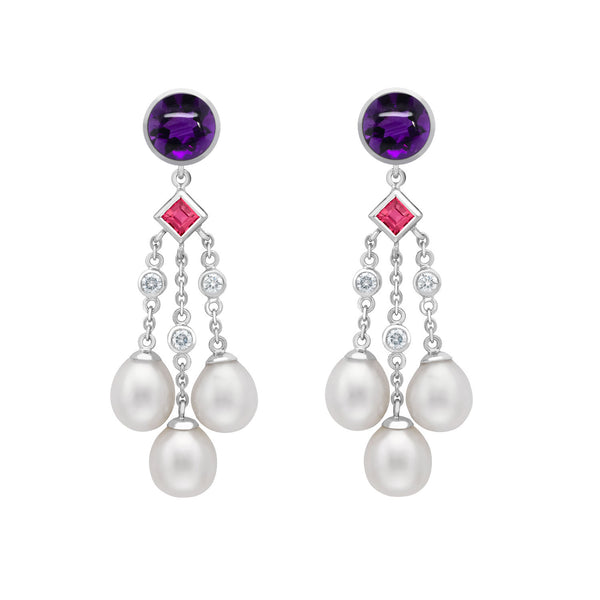
Pearls enjoy an exalted and romantic place in jewellery and being organic gives them a singular place in its history. We have used them forever in all their wonderful variety of colours and shapes.
Elegant and adaptable and always wearable they are one of our favourites to work with.Pearls can be saltwater or freshwater and produced entirely by a natural process or they can also be cultured whereby the growth is artificially initiated. They are formed in molluscs (oysters or mussels) as a defense against an irritant such as a parasite. The mollusc reacts by encasing the irritant in layers of nacre, which is a hard calciferous material like their own shells.
Natural pearls are becoming increasingly rare and highly sought after with top quality examples costing hundreds of thousands of pounds. They were traditionally found in some of the most beautiful areas of the world, the Persian Gulf, Gulf of Manaar (between Sri Lanka and India), and the South Pacific for South Sea pearls.
The pearls were collected by free divers who were able to descend a long way on a single breath with no equipment. Cultured pearl production is now a huge industry but began in 1896 when Kokichi Mikimoto first succeeded in his ambition to create pearls. It took a few years to perfect the procedure, whereby a shell bead is implanted into an oyster around which the pearl will form, with good quality Japanese cultured pearls first appearing on the market around 1905. Needless to say the price difference between natural and cultured pearls is huge and only increasing.
Pearls come in a wide range of sizes, colours and even shapes. The tiniest are seed pearls which are only about 1mm whilst the largest are the South Seas which have been known to exceed 20mm in diameter. Naturally, they come in colours such as white, grey and golden largely depending on where they grow and what the oyster or mussel eats. As a natural, organic product, pearls need to be treated with some care as they can be damaged by hair spray, scent and many cosmetics. They should be cleaned with warm water and a soft cloth and as the old adage goes, “be the last thing you put on in the morning and the first thing you take off at night.”
In ancient China, pearls were believed to guarantee protection from fire-breathing dragons, whereas in Europe, they have traditionally been associated with purity and innocence, hence their popularity in wedding jewellery. We like to spice things up and mix these beautiful lustrous gems with our signature skulls, crosses, bees and bright colourful stones.
Description: Pearls are one of the earliest gems used for self adornment and were once more highly valued and sought after than diamonds. They come from both rivers and seas and being organic are fairly soft.
Hardness: 3 on Mohs Scale
Birthstone: June

Peridot
The word peridot comes from the Arabic ‘faridat’, which means ‘gem.’ Most peridot formed deep inside the earth and found its way to the surface via volcanic action, as indeed did diamonds. Traditionally associated with light, the Egyptians referred to it as the ‘gem of the sun’. Some believed that it protected its owner from ‘terrors of the night’, especially when it was set in gold, others that it would ward off evil spirits.
Major mining areas are found in Burma, Pakistan, the USA and China although it can be found in various other countries including Norway, which mines slightly paler coloured stones with real lime hues.
Description: Peridots are the gem quality variety of the mineral Olivine and are prized for their intense green colour and life; they are found in Burma.
Hardness: 6.5 – 7 on Mohs Scale
Birthstone: August

Pertified Wood
It occurs when trees fall and get buried by layers and layers of earth and sediment which compact down and seal the timber off from oxygen thereby protecting it from decay. When mineral rich water flows slowly through the sediment it replaces the original organic material with inorganic minerals such as silica.
This results in a material that looks ‘woody’ in appearance but is hard and cold like stone to the touch.It can be found in huge slabs big enough for table tops but is most often seen cut into slices or used for carvings. The typical colours are varying shades of brown, grey and deep orangey red with green/blues and pinks more rare, all colours are dependent on the differing mineral content of the water. Areas of petrified forest can be found across the globe from America to India and Argentina to New Zealand.
Description: Petrified Wood is not, as its name might suggest, terrified but rather it is wood that has been fossilized over millions of years! It is found all over the world.
Hardness: 7 – 8 on Mohs Scale

Phi
Talismanic and beautiful in its simplicity, Phi is the ancient Greek symbol of the golden ratio, the sign of harmony in all things. Jewellery emotionally charged and to last many lifetimes- this is not an ephemeral whim of fashion. They are beautiful examples of perfect unity between design and craftsmanship, elegance and thoughtfulness.

Platinum
A dense, malleable grey-white metal which is one of the rarest with only a few tonnes mined each year, its rarity makes it highly valuable and its hardness and tarnish resistance make it ideal for use in jewellery. Platinum has required a legal hallmark since 1975, it is marked 950 which means it is composed of 95% platinum together with 5% additional alloy.
It is one of only three Noble Metals in general use. It is tough and exceptionally non-corrosive but became popular relatively late in life, at the beginning of the 20th century, as a jewellery medium.
It was a perfect material for the very geometric designs of the time and its hardness made it perfect to use for claws in which to set stones in the emerging diamond-based designs of so much of the jewellery of the time.

Polishing
Most jewellery and silverware is pre-polished to give it an evenness on which the last few touches can be carried out, say setting for jewels and engraving for silver, and they are then polished, at the end of all the work having been carried out on them to burnish and finish the pieces.
Being the final job polishing can make or break a piece and is a real art form at its best. Polishing is done by mops made of different hardnesses of material and with different polishing substances on them used one after the other to gradually build up the polish to the brilliant finish we are all familiar with. It is a dirty and dangerous job but absolutely vital as bad polishing can ruin hours of great work and good polishing enhance it.
As well as polishing, the polisher will also use other finishes on a piece.
Gilding and Gold Plating – The covering of various areas of, or the whole piece, in Gold plate. This can be done on most metals but, normally, Silver. There are various different colours and purities of gold used to do this.
Oxidising – Specifically on silver, oxidising is used to give an antique, blackened look and to give contrast to a piece.
Rhodium – A rare, hard, silvery white precious metal, a member of the platinum group, it is used in jewellery to plate white gold to improve appearance and to plate silver to prevent tarnishing.
Lustre – This refers to the amount of light reflected off the surface of a gem, and is influenced by both the hardness of the stone and how well it has been polished, essentially – how shiny is the surface of the stone.
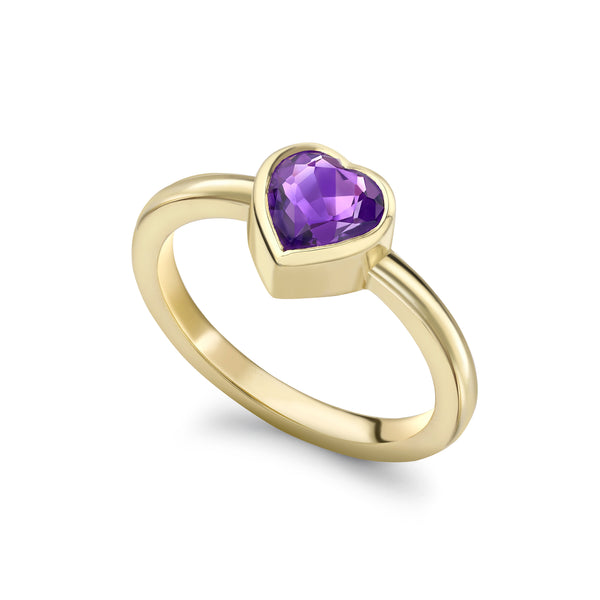
Precious Few
We love unusual and beautiful smaller stones. An unusual colour or cut can make a petite and relatively inexpensive gem unique. These are the basis of this collection. Every Precious Few ring is a handmade one-off and each rare and beautiful stone is set in a mount designed especially to flatter it. Worn solo or stacked it is an accessible way to have wear rare stones.

Reveal
Theo Fennell’s exquisite Reveal rings are typically elegant and beautiful. The Diamond rings are set in a unique and subtle way, allowing light to shine through each and every facet of the stones, creating the maximum sparkle from such a delicate piece.
The Reveal Diamonds are available in a variety of different carat weights and cuts including princess, brilliant, oval, emerald, pear and heart shaped. As well as the simple solitaire settings, duo and trio Reveal rings are notably impressive, though nonetheless elegant and subtle.
Ripple
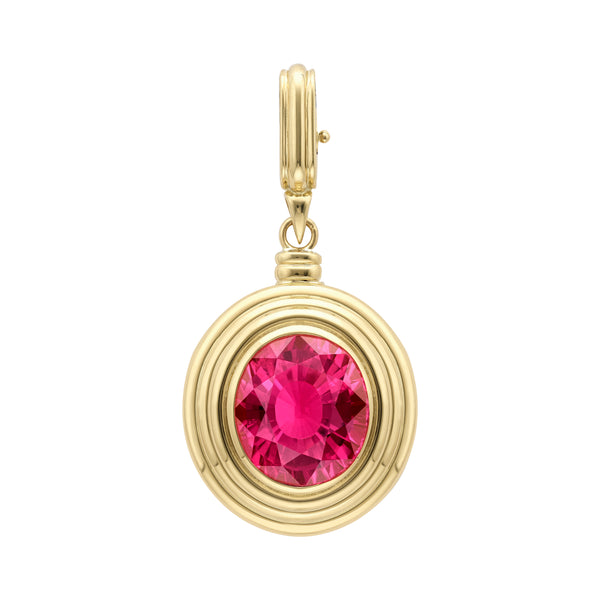
Ripple is a type of setting we have championed for years, simple and elegant, it allows the stone to be the hero of the piece and provides a visual, gold echo around it and allows a selection of different shapes and colours to be worn together in harmony.

Rock Crystal
Rock crystal has been used in jewellery for thousands of years, some of the earliest beads and amulets are made of this gem material. It was easy enough to carve and polish but hard enough to withstand wear. It can sometimes contain attractive inclusions such as fine needles of golden rutile which is referred to as ‘angel hair’ quartz. It is found all over the world but some of the most important mining areas include Brazil, China and the USA.
We use it to make our rather brilliant Lightbulb collection where its high transparency allows the light to reflect off the gold behind the rock crystal creating a truly luminous effect.
Description: Rock Crystal is the colourless, transparent variety of Quartz which is one of the most abundant minerals on earth. It can occur in huge crystals
Hardness: 7 on Mohs Scale

Rubellite
Rubellite is a name given to members of the tourmaline family that have a really distinctive red or bright pink colour. There are many Tourmalines in the red and violet spectrum but only the most resonant in colour can be called Rubellite.
Even the best stones often have inclusions but, so long as they don’t cloud the stone, they are normally tolerated, even by aficionados, but the cleaner the better. The best come from Brazil, Nigeria, Mozambique, Madagascar and Pakistan but some fabulous stones come from the USA also. These are beautiful stones in their own right and should not be thought of as too much the poor relation of Rubies and Spinels.
Description: Rubellite is a bright red or pink member of the Tourmaline family and one of its most exclusive and expensive members.
Hardness: 7 – 7.5 on Mohs Scale
Birthstone: Scorpio and Sagittarius

Ruby
Ruby can range from brownish-red through pinkish-red to the ideal bright, deep red of the most valuable and sought after stones. The colour is caused by the presence of chromium. The higher the concentration the truer the red. Chromium can also cause fluorescence which contributes to the ‘glowing hot coal’ appearance of some rubies.
The finest quality stones traditionally came from Burma, the colour of which is often referred to as ‘Pigeon Blood’ but other important sources include Vietnam, Thailand and more recently Tanzania and Mozambique where Gemfields are mining some particularly fine stones.
Rubies have been prized for thousands of years across many cultures, they are mentioned several times in the Bible – the quote “The price of wisdom is above rubies” being familiar to most – by Pliny in his Natural History and were referred to as “the king of precious stones” in the ancient Sanskrit language.
Ruby is the anniversary stone for 40 years of marriage, by which time they are well deserved! They are available in a wide spectrum of prices meaning we are able to source stones suitable for a range of projects.
Description: Ruby is the red variety of the Corundum family, all other colours being Sapphires, some of the most beautiful stones come from Burma.
Hardness: 9 on Mohs Scale
Birthstone: July

Blue Sapphire
We use a variety of colours of Sapphire, including pink, yellow, green and purple along with the most popular and best known colour – blue. The most highly valued blue stones have a rich velvety colour coupled with a bright lively appearance and few inclusions.
Traditionally the best stones were believed to come from Kashmir and these still command the highest prices today along with those from Burma. Other sources include Sri Lanka, Thailand and Australia.
A particularly rare type of Sapphire is a beautiful blush pinkish-orange colour referred to as Padparadscha which means ‘Lotus blossom’ in Sinhalese. Second in hardness only to Diamond, Sapphires (like Rubies) are a good choice for jewellery that will be worn every day such as engagement rings. Also like rubies, they are available in a huge range of prices so there are stones to suit every pocket.
They were associated with the virtues of truth, sincerity and faithfulness and were credited with the ability to protect wearers from fraud, treachery, poison and plague – how can any of us manage without one?!
Description :Sapphires belong to the Corundum family and occur in all colours of the rainbow except for red, because the red variety is Ruby. They can be found in Sri Lanka, Burma and Thailand amongst other places.
Hardness: 9 on Mohs Scale
Birthstone: September

Pink Sapphire
We use a variety of colours of Sapphire, including pink, yellow, green and purple along with the most popular and best known colour – blue. The most highly valued blue stones have a rich velvety colour coupled with a bright lively appearance and few inclusions. Traditionally the best stones were believed to come from Kashmir and these still command the highest prices today along with those from Burma. Other commercial sources include Sri Lanka, Thailand and Australia.
A particularly rare type of Sapphire is a beautiful blush pinkish-orange colour referred to as Padparadscha which means ‘Lotus blossom’ in Sinhalese. Second in hardness only to Diamond, Sapphires (like Rubies) are a good choice for jewellery that will be worn every day such as engagement rings. Also like rubies, they are available in a huge range of prices so there are stones to suit every pocket.
They were associated with the virtues of truth, sincerity and faithfulness and were credited with the ability to protect wearers from fraud, treachery, poison and plague – how can any of us manage without one?!

Yellow Sapphire
We use a variety of colours of Sapphire, including pink, yellow, green and purple along with the most popular and best known colour – blue. The most highly valued blue stones have a rich velvety colour coupled with a bright lively appearance and few inclusions. Traditionally the best stones were believed to come from Kashmir and these still command the highest prices today along with those from Burma. Other commercial sources include Sri Lanka, Thailand and Australia.
A particularly rare type of Sapphire is a beautiful blush pinkish-orange colour referred to as Padparadscha which means ‘Lotus blossom’ in Sinhalese. Second in hardness only to Diamond, Sapphires (like Rubies) are a good choice for jewellery that will be worn every day such as engagement rings. Also like rubies, they are available in a huge range of prices so there are stones to suit every pocket.
They were associated with the virtues of truth, sincerity and faithfulness and were credited with the ability to protect wearers from fraud, treachery, poison and plague – how can any of us manage without one?!
Description: Sapphires belong to the Corundum family and occur in all colours of the rainbow except for red, because the red variety is Ruby. They can be found in Sri Lanka, Burma and Thailand amongst other places.
Hardness: 9 on Mohs Scale
Birthstone: September
Scrimshaw
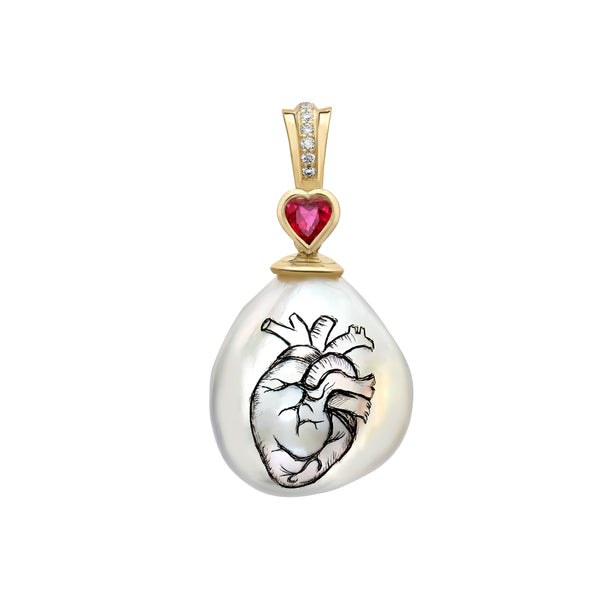
Scrimshaw is the age-old technique of carving on bone, perfected by sailors on interminable journeys in the age of sailing ships. It is now largely a lost art, except to ancient societies living in cold and inhospitable places. We use it on pearls which suit the medium perfectly and gives a wonderful, illustration-like effect.

Setter
This is the craftsman who actually sets the stones in to jewellery. Some of his vocabulary are:
Pavé – a style of setting whereby many small stones are all set close together in a seemingly random way to resembles a cobblestone pavement.
Rubover – a style of stone setting whereby metal completely surrounds the stone and is pushed, or rubbed, over the edge to hold it securely in place.
Facet – one of the flat polished faces of a gemstone.
Claws – the small prongs of metal that fold over a stone in a piece of jewellery to hold it in place.
Cabochon – a style of fashioning gems into a smooth polished dome.
Inclusions – These are internal features such as tiny crystals of other minerals caught up during the development of the larger host gem crystal. They can be used to identify gemstones, where they are from or whether the stone is natural or synthetic.

Silver
Pure Silver has a brilliant white metallic lustre. Ductile and malleable, Silver has the highest electrical and thermal conductivity of all metals. Marginally harder than Gold, Silver is less expensive and is ideal for use in making jewellery, making tableware, objects and hollow-ware as well as Silver.
In some cultures it is given almost mythical status, for instance among the Navajo, and where it is readily available it has bred an entire art form, like Mexico and Peru. It is one of only three noble metals, along with Platinum and Gold, in general use.
Although Silver jewellery has become popular, in part because it costs so much less than gold, it is still seen as the younger brother of Gold.

Silversmithing
Silver comes into its own when used by silversmiths, some of whom have attained the reputation of great artists in their own right. It is still one of the great areas of traditional craftsmanship and artistry and London is, without doubt, its center of excellence. There are various types of silver-ware and techniques used to make it, amongst which, traditionally are:
Hollow-ware – Refers to silver that is hollow, so teapots and trophies, tankards and bowls.
Flat-ware – Mainly cutlery and serving tools.
Casting – The rendering of a model (often made in wax) into metal by pouring molten metal into a mould.
Spinning – Making a bowl shape by spinning a metal disc using a variation of the technique used by a potter.
Hand Raising – Beating sheet silver into a shape by using tools and human strength to manipulate the metal into the required form.
Repousse – Sometimes referred to as Chasing. Hammering the sheet metal from behind to produce a raised pattern or shape.
Chasing – As above but, more widely, a variation of engraving used to get a specific finish, say the coat of an animal, or image, Normally by cutting into the metal.
Planishing – Hitting the metal with a hammer to get a shape, and surface effect of mottled appearance.
Forging – As a blacksmith would do except with more subtlety in silver!
Stamping – Would be used to make a coin or anything that required the same, shallow image, repeated many times.
Piercing – Cutting out a pattern or hole from a piece of metal.
There are many more techniques, some arcane and others not often used.

Skull
The Skull is one of the most ancient symbols in all of jewellery and one that has been used by Theo since the seventies (can it be?!). The techniques, materials and brilliant craftsmen he has used over this time has redefined what can be done with this iconic symbol. Not just an icon of death but of sex & rebirth, of our dark sides.

Slinky
Slinky, figure-hugging strands that cling to the body like no other diamond jewellery. The trick is in the design and the movement between each link. Draped around necks and wrists, down backs and cleavages, it’s like having a second skin.
Tantalising. This exquisite Diamond Suite is a masterpiece of classic design; simple and beautifully hand-crafted. The effortless movement and fluidity of both pieces are testament to the brilliant craftsmen who have created them, and their unrivalled skills.

Spangle
Theo’s incredibly popular Spangle collection features Sapphires, Rubies and Blue Diamonds. Make an elegant and understated highlighted with the Spangle collection. A simple, stylish collection of Gold rings bands lightly dusted with Diamonds. Spangle is ‘neat but not gaudy’ as the poets would say; and so do we.

Spinel
Historically, Spinels were frequently misidentified as rubies, one of the best known examples of this can be seen in the Crown Jewels where the ‘Black Prince’s Ruby’ is actually a Spinel. It weighs about 170 carats and is set above the Cullinan II diamond in the Imperial State Crown. It is one of the oldest of the Crown Jewels, having been acquired in 1367, by the Prince of Wales – Edward of Woodstock (who came to be known as The Black Prince) as payment for a battle victory abroad.
Spinels are known to exhibit an array of unusual optical effects, including ‘asterism’ – whereby three intersecting bands of light reflection form a star shaped pattern on the stone, ‘chatoyancy’ or ‘cat’s-eye’ which is one single band of light reflection bisecting the stone, (both of these require the stone to be cut as a cabochon in order to see the effect) as well as a ‘colour change’ effect where some stones will appear different colours or shades of the same colour when viewed in differing light conditions.
Amongst the most important current commercial sources are Burma, Tanzania and Vietnam and some of the rarer colours are extremely rare and expensive.
Description: Spinel occurs in a range of colours, from various shades of blue through purples and pinks to hot vivid reds, they can be found in Tanzania and Burma amongst other places.
Hardness: 8 on Mohs Scale

Stone Engraving
Many stones can be engraved by cutting a pattern into the surface of the stone, cutting away stone to leave an image standing proud or cutting deep into the reverse of a cabochon stone to leave a 3D reverse image. Often engraving on stones will take the form of an heraldic design, a monogram or symbol but sometimes the technique will be more complicated; here are some examples.
Cameo – Is the process of cutting away at stones or shells that often have two colours sandwiched together to leave an image standing proud, in relief, of its surroundings.
Intaglio – Is essentially the reverse and is the process of deep engraving an image into a stone.
Essex Crystals – Are reverse Intaglios and are very skilfully engraved into the back of cabochon, or un-faceted, rounded stones, so that they give the impression of being inside the stone. These are often painted to give the illusion of an image floating in the stone, not unlike a glass paperweight in miniature.

Tanzanite
Tanzanite was first discovered relatively recently in 1967 when Masai tribesmen found a cluster of crystals in the Merelani Hills in north east Tanzania near Mount Kilimanjaro, an area that remains the only known location for this beautiful gem.
It is not one of the harder stones and has a tendency to brittleness so care needs to be taken, particularly when set as a ring but its beauty and rarity make it highly prized.
The best stones exhibit a strong blue colour with a violet tint and a bright lively appearance. They are strongly pleochroic which means they exhibit different colours in different directions through the crystals. An untreated stone will typically show blue, pinky-violet and yellow.
Most stones on the market today have been heated to turn them from brown to blue with the best colours being seen in larger stones where the colour is most intense and displayed to best effect.
Description: Tanzanite is the transparent purplish blue variety of the mineral Zoisite, it is found only in Tanzania (hence the name).
Hardness: 6.5 – 7 on Mohs Scale
Birthstone: December

Topaz
Colourless topaz is very common and it is this material that is typically treated to make the well known blue colour that is widely seen in jewellery.
Most Topaz is known simply by its colour i.e. Pink Topaz, however Imperial Topaz which is a reddish-orange and is the most sought after and valuable colour was named in 19th Century Russia. At this time, the Ural Mountains were the primary source of these stones and they were named after the Russian Tzar and his family as a mark of honour and respect.
Topaz can cleave quite easily so care is needed when cutting, setting and wearing. Current primary sources for this lovely gem are Brazil and Madagascar.
Description: Topaz occurs in a wide range of colours including various shades of yellow, orange, blue colourless and pink. Found in Brazil.
Hardness: 8 on Mohs Scale
Birthstone: November

Tourmaline
The chemical make up of tourmaline crystals is highly complex which allows for a huge range of colours, shades and hues to develop. Some are known by particular names, e.g. the deep pinkish-red stone Rubellite whilst others are referred to simply by colour, e.g. Green Tourmaline.
Some stones combine areas of different colours within the same gem, known as parti-coloured or bi-coloured stones, the most well known being the pale pink and green Watermelon Tourmaline.
Currently the hugely sort after and most highly prized variety is the electric neon blue Paraiba Tourmaline. Only discovered in the late 1980’s and named after the state in Brazil where they were originally found, clean stones of a good size and colour are rare and therefore extremely expensive. The intense colour of these stones is caused by copper and so gems of this variety, new deposits of which have very recently been found in Africa, are often referred to as Cuprian (meaning ‘copper bearing’) Tourmalines.
Description: The Tourmaline family of gemstones is notable for having a wider variety of colours than any other gem. It can be found in many places from Madagascar to California and Brazil to Afghanistan.
Hardness: 7 – 7.5 on Mohs Scale
Birthstone: October
Trumpet
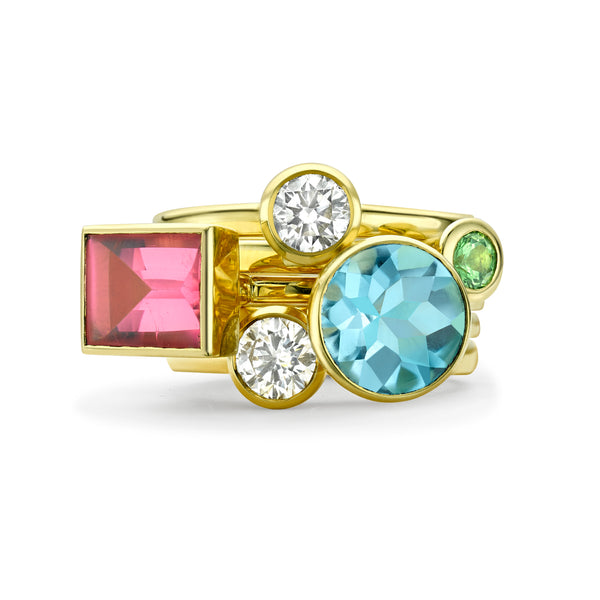
Trumpet echoes the flair at the end of the instrument and makes a wonderfully simple setting for bright stones in a variety of shapes and sizes.

Tryst
Tryst is an old fashioned way for modern lovers to express their feelings; it has been beautifully crafted from a wide choice of the most perfect materials and symbols that make each piece utterly individual whether ‘off the peg’ or bespoke.
These timeless pieces feature some of Theo’s best loved motifs – from the bee to the starfish – and his beautiful attention to detail, of course! A happy bee of industry, blossom for hope, the skull for a memento mori: these pieces have been designed to give jewellery back its heart.
Tryst can be tailored entirely to the wearer from the stone and the setting, to all the detailing. Each piece is totally unique so whether ‘off the peg’ or bespoke, a Tryst piece makes a unique and intimate gift. The more apt the details the more intimate the present. Let your heart rule…

Turquoise
Turquoise has long been used for jewellery, being highly valued by ancient cultures including the Egyptians and South Americans. Typically it was carved into beads and cabochons but was also used for inlay work. It was believed to be a protective stone, guarding wearers from injury (highly recommended for the accident prone then!) and encouraging health and good fortune, whilst hunters would wear it to guarantee a successful hunt.
Throughout history the finest turquoise has been found in the mountainous region of North Eastern Iran near the city of Nishapur. Today however, much commercial mining is carried out in the South Western states of America including Nevada and Arizona where there are dozens of mines, the most famous being Sleeping Beauty.
Description: Turquoise is a vibrant green-blue opaque gemstone that is prized for its wonderful colour which is caused by copper. It is found in Iran, the South-West of America and China amongst other places.
Hardness: 5 – 6 on Mohs Scale
Birthstone: December
Venym
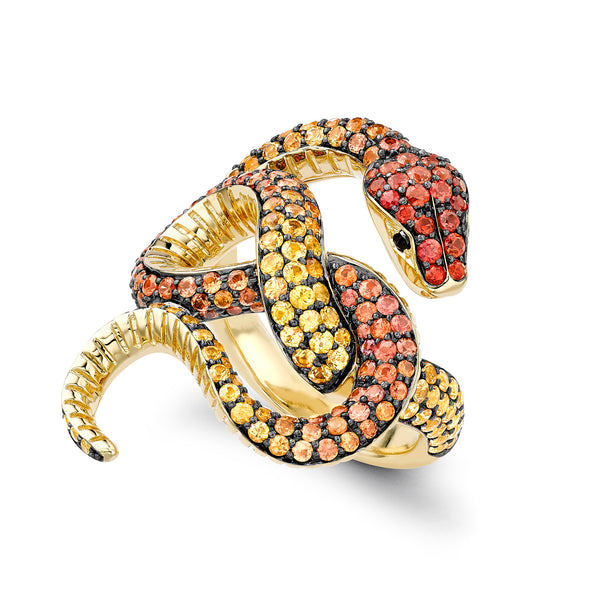
So much serpentine jewellery doesn’t reproduce the sinuous shapes made by a real snake. In many colour variations, Venym suggests the actual movements and shapes of a real reptile, set in an abundance of pave colours.
Waterlily
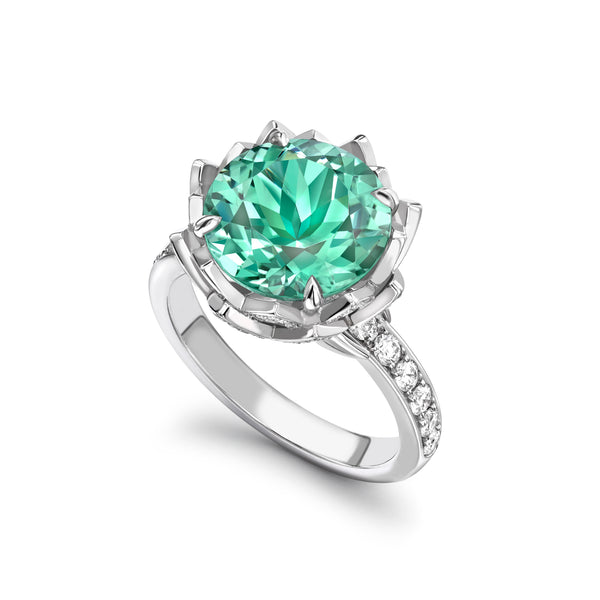
The Waterlily setting is a misleadingly simple but very subtle design that reflects the many graceful petals of its namesake. The mount manages to show off a stone to it best advantage yet can be set with diamonds to make a really gorgeous setting. It particularly suits diamonds and more pastel, watery stones. It transforms a subtly coloured stone into a perfect piece of jewellery.
Whip
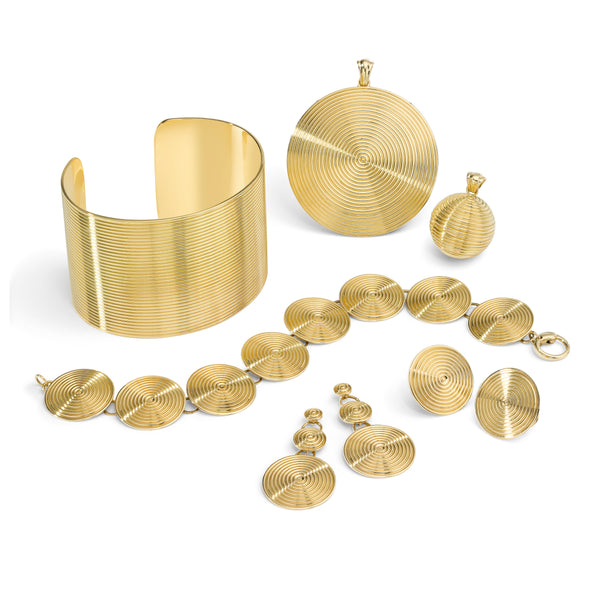
The new Whip collection was inspired by the whipping that attaches the head of a polo stick to its shaft and binds very fine rattan chair legs. It has a wonderful, crisp and linear look. I first saw it on old, beautifully made pieces of furniture and luggage, bound by hand. We used Whip years ago and it worked so well – that now we’ve designed a new collection. We think it’s very chic, very simple, but very stylish.

Zircon
Zircon is not one of the hardest gems and has a tendency towards brittleness, so care must be taken in the cutting, setting, wearing and cleaning of these gems. Colourless stones are also common and these were sometimes used as a diamond imitation in the early 20th Century, falling out of fashion when better and cheaper imitations became available.
Historically it was believed the stone could imbue the wearer with wisdom and riches whilst also having the power to drive away evil spirits. Commercial sources of this gem are Australia, Burma, Sri Lanka and Thailand.
Description: Zircons occur in a range of colours including blue, yellow, brown and green and have a particularly bright lustre and high dispersion. Found in many locations including Sri Lanka.
Hardness: 6.5 – 7 on Mohs Scale